
I was building a portable speaker project.
But, when I connected the battery for the first time, it didn't work. Nothing happened.
I checked my connections but couldn't find any errors.
What to do??
That's when an oscilloscope comes in handy.
An oscilloscope is a very useful tool that will let you "see" the voltage in real-time".
What Does an Oscilloscope Do?
The oscilloscope measures voltage over time. This means that it lets you "see" the signal in the circuit as it changes with time.
For example, if you measure the voltage across a blinking LED with an oscilloscope, you'll see something like this:
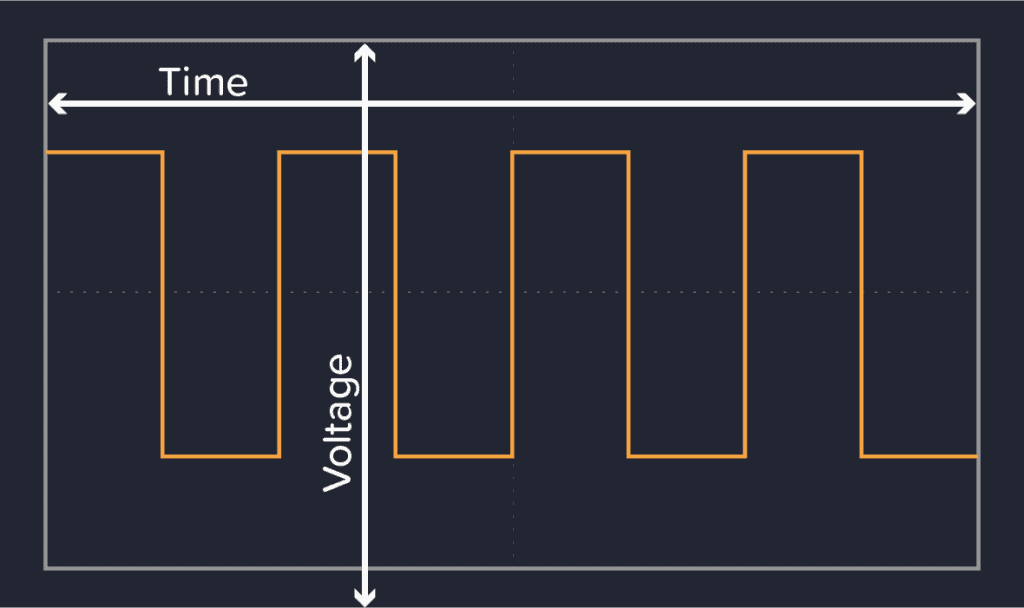 |
The orange line represents the voltage. When it is on top, the voltage is high and the LED is on. And when it's at the bottom, the voltage is low and the LED is off.
You can now "see" the voltage by looking at the orange line.
This becomes extremely useful once you need to see changes that happen very fast, such as with audio signals. Or say, if you want to confirm that the PWM signal you've set up on your Arduino is actually working.
Or if you're just curious about what the signal sent from one component to another looks like.
Anyway, by looking at the voltage at several points in the circuit with the oscilloscope, I could see where in the circuit I had the audio signal and where it had disappeared.
Turns out one of the transistors was missing a connection. I soldered the connection, and voila! The circuit worked.
If you're an Ohmify member, you can access the new course Learn To Use an Oscilloscope which will get you up and running with the oscilloscope in no time.
Keep On Soldering!
Oyvind @ Build-electronic-circuits.com
PS: If you're new to electronics - or trying to get back into it - here are two ways I can help you learn electronics:
- Ohmify is for people like you who are interested in electronics and want to learn skills like basic electronics, soldering, circuit design, Arduino, and much more - while also building practical projects along the way.
- My eBook Fun Circuit Experiments with Sound and Light is a short book where you'll learn basic electronics through experiments. If you're new to electronics, this is the perfect place to kickstart your learning.
- Get link
- X
- Other Apps
- Get link
- X
- Other Apps
Comments
Post a Comment